


We’ve created this toolkit to help programs, organizations, directors, supervisors and every team member celebrate National Home Visiting Week along with us!
National Home Visiting Week is open to ALL home visiting and family support professionals across the country!
Celebrating home visiting isn’t limited to certain program models or only a handful of organizations. It’s open to all professionals offering home visiting support services to families all across the country.
The toolkit contains:
Celebration Ideas • Storytelling Tips • Press Release Examples • Letter the Editor Sample • Data Sharing Tips • NHVW Logos & Social Media Assets • Merchandise • Poster Graphics • State/Local Proclamations & MORE!

How to Use the Toolkit
Use these toolkit resources for messaging tips, templated materials and promotional assets. It is designed to be shared widely; you are granted permission to use or modify the contents of this toolkit to promote home visiting and celebrate your program and team of family support professionals during #NHVW…or all year long!
Download the full toolkit PDF here or keep scrolling!
2026 NHVW Toolkit Contents
-
![Graphic promoting social media engagement with speech bubbles showing like and love icons, a location marker with hands, and stars, for National Home Visiting Week 2026.]()
Social Media
Follow the Institute on social media and share/reshare posts about National Home Visiting Week. Programs from all over the country post about NHVW, so share/like/repost their posts as well! We’re all celebrating home visiting from everywhere and every program during NHVW!
Create social media posts from our provided graphic assets or use them as inspiration for your own posts! NHVW social media graphics and logos can be found HERE.
We have a Facebook, Instagram (NEW!) and LinkedIn page. Please tag us in all your posts and utilize the hashtags, so we can see and engage with you. If you don’t use these tags or tag the Institute, we are unable to fully track and capture our impact and may not see your posts.
-
![A colorful illustration promoting Letters to the Editor for National Home Visiting Week, featuring a newspaper with icons of a speech bubble, a location pin, and a hand, with the text "Letters to the Editor" and "National Home Visiting Week."]()
Letters to the Editor
You can let your local newspaper or magazines know about National Home Visiting Week and take this opportunity to educate the community on the importance of home visiting.
You’ll find a sample letter HERE, but please personalize with relevant data points, anecdotes or highlights about how your program is making a difference. If you plan to send to multiple outlets, ensure that each submission is unique and tailored to the right audience.
Be ready with a local angle and data to back up the impact in your community. And know you can submit as many as you see fit to get your message out!
-
![Illustration promoting press releases for National Home Visiting Week 2026, featuring people using devices, news graphics, and a hand icon on a location marker.]()
NHVW Press Releases
Use one of our Press Release templates to notify media and your community of National Home Visiting Week.
The first press release template can be used and adapted by anyone; the second template is designed for programs or entities with a connection to a selected National Home Visitor of the Year (or it can be altered if you host your own ‘awards’ for your team.
Be ready with a local angle and data to back up the impact in your community.
-
![Design promoting National Home Visiting Week 2026, featuring a gold trumpet, a logo with a hand within a location pin, and the text 'PROCLAMATION,' 'NATIONAL HOME VISITING WEEK,' '#NHVW,' and '2026'.]()
State/Local Proclamations
Use the Proclamation Template to ask your governing municipality or state to issue a proclamation recognizing National Home Visiting Week.
Your municipality may be your city council, county commissioner or your state governor. Keep in mind that many states require that the request be made months in advance of April. You will be more successful if the request is made by a resident of the governing municipality.
Think outside the box: Have your program director or board of directors offer a proclamation/recognition of NHVW to your organization and community!
-
![community at event celebrating]()
Host a Community Event
Hold a community event celebrating home visiting. This could be in conjunction with an existing parent-education or community group. It can be big, or it can be small. At your event you could:
Honor local home visitors that go above and beyond the call of duty, have earned the national designation of a Certified Family Support Professional or have earned a tenure milestone such as five years or more employment.
Honor families that have graduated from your program in the past year.
Choose and honor a state, tribal or territorial home visitor of the year.
More celebration ideas can be found below!
-
![Illustration promoting National Home Visiting Week with a pink megaphone, social media icons, emojis, and a location pin on a light blue background, featuring hashtags and event details.]()
Use the Hashtags
Be sure to use the NHVW hashtags and tag the Institute (InstituteFSP) in all your posts. That’s how we gain traction in spreading the news!
Utilize the following hashtags, so we can see and engage with you. If you don’t use these tags or tag the Institute, we are unable to fully track and capture our impact.
#NHVW #NHVW2026 #NationalHomeVisitingWeek #HomeVisiting #HomeVisitingHeroes
Ways to Celebrate National Home Visiting Week!
We’ve compiled a list with tons of ideas and examples of how you, your team and your program can participate in National Home Visiting Week! From “easy and free”, to some that require a bit more planning…and budget, you can pull off a special celebration that is meaningful to you and your team.
These ideas are examples of what programs pulled together last year, or are already planning for 2026! Use them as inspiration for your own celebrations for home visiting and the professionals who make this field so special.

More NHVW Tips & Tricks
-
Last year we were asked how organizations could budget for NHVW? How do they classify it in their budget? To answer that question, I would ask this question: What is your primary purpose for celebrating NHVW? If it is to retain your current home visitors, I would include NHVW activities in your Organization Retention Plan. In your budget, label it as retention activities in either your supply line item or if contracted with a third party it would then fit into the contractual services. Most appreciation events are for the primary purpose of retaining your current home visitors with possible secondary purposes of elevating home visiting as a career path, informing your community of the home visiting services you offer and the impact of home visiting. The secondary purposes listed here all contribute to recruitment and retention strategies and can be labeled as such in your budget.
We love our home visitors! However, home visiting is primarily funded with taxpayer funds, so everyone needs to be conservative and modest in your budgeting. If you are a charitable organization and can ask for donations, you may be able to offset the costs of your celebration with donations. At the Institute, our entire national campaign is funded on donations. While we think home visitors deserve a spa treatment at an island resort, it is more aligned to offer a meal at your community center. Who knows, maybe you can get a massage therapist to donate some time during your meal?
We can’t wait to see the splash that #NationalHomeVisitingWeek is going to make!
Janet Horras, Institute Executive Director
-
Human interest stories combined with data work best. That means having a pre-approval from a home visitor and/or a family being served by a home visiting program to share how home visiting works and how it has made a difference in the lives of people in your community. See our data tips in the next section.
Keep it concise but powerful. Think about your elevator speech for home visiting and distill your message into something everyone can latch onto.
Pull at heartstrings with your headline. You only have a few seconds to grab and keep someone’s attention. Here are some examples:
“Home visiting changed my life”
“Home visiting levels the playing field for child learning success”
“My home visitor believed in me: How family support professionals promote confident parenting”
“Home visitors have a front row seat to family success every single day”
Avoid hot button topics or aligning with a single political party. We have plenty to talk about without triggering a negative reaction or alienating others. Home visiting has always enjoyed bipartisan support—it’s hard to be against supporting parents to get their babies off to the best possible start.
Ensure transparency and privacy when working with families and home visitors. As you’re telling personal stories, it’s important that you honor confidentiality and inform parents and home visitors what is expected from them. They will likely need to provide at least their first name. Before any interview, help them feel more comfortable and practice with them what they are willing and ready to share publicly. There’s no one better to explain home visiting than someone who is in the thick of it, but the very nature of the work is personal.
-
Simplify the data. Avoid using jargon or overly complicated information about model differences or particular funding streams. Our purpose is to elevate the home visiting story.
Output data matters. People understand the number of families served or the number of children served, or the number of home visits provided. You might also select one data point that is meaningful to your specific community or population, such as the percentage of women screened for postpartum depression.
Share data in small quantities. Use three to four data points at maximum. Remember most people don’t understand the importance of different assessment results. Choose data points that are understandable and relatable to the general population. Most people understand the following:
Reduction in pre-term births
Developmental screening results (how many children were on track for school success when they left your program)
Parents educational gains while in your program
Present data in various ways. Use data in your storytelling but follow up with the same data in writing. Also, it really helps to convey data in a visually appealing manner to illustrate what you are describing.
Avoid data that will alienate some people or make them think all we do is focus on reproductive health as one example.
Highlight positive data. You are trying to put home visiting in the best possible light. If you are asked directly a question about data that might be negative, then please be forthcoming. An example of a negative question would be, “How many families drop out of your program?” You can respond with the percentage if you know it, or you can say, “Too many. We want to reach every family and be successful. Unfortunately, not every family is ready for our services. We do have very good luck with families that have dropped out and later re-enroll when they are ready for home visiting.” Another possible response to the question is, “Unfortunately many of our families are in crisis situations and are focused on day-to-day survival. It is a challenge to engage a family that is in survival mode into a developmental relationship.” Go out of your way to highlight positive data but be prepared if and when a question like this comes up.
Don’t forget the human element. Sharing data that is compelling without being overwhelming is a talent and takes some practice. Data is best shared in conjunction with a human-interest story. Decision makers want data, but the story is what will draw them in.
-
The National Home Visiting Resource Center compiles key data on early childhood home visiting, a proven service delivery strategy that helps children and families thrive and creates the annual home visiting yearbook.
The 2025 Home Visiting Yearbook features updated information from robust data sources, including 17 evidence-based and 11 emerging models. Key takeaways include:
Evidence-based home visiting was implemented in all 50 states, the District of Columbia, 5 territories, 32 Indigenous communities and 65 percent of U.S. counties in 2024. (Reach has expanded - this is an increase from 2023!)
More than 284,000 families received evidence-based home visiting services in 2024, throughout more than 3 million home visits. Approximately 14 percent of these visits were provided virtually, down from nearly 23 percent the prior year, reflecting a continued return to in-person visits.
Over 70,000 additional families received home visiting services through 11 emerging models that provided more than 625,000 home visits in 2024.
More than 20,000 home visitors and supervisors delivered evidence-based services nationwide in 2024.
More than 16.9 million pregnant women and families (including over 22 million children) could benefit from home visiting. Of those, approximately 284,000 received services in 2024— only 1.7 percent of all potential beneficiaries or 3.6 percent of high-priority families.
How You Can Use this Data
Sample intro statement:
In 2024, evidence-based home visiting was implemented in all 50 states, the District of Columbia, 5 territories, and 32 Indigenous communities, which includes 65% of US counties. [Insert model specific data about footprint in your state, ie: In Illinois, XX is implemented in XX counties]
Read the full Home Visiting 2025 Yearbook here: 2025 National Home Visiting Yearbook
National Home Visiting Resource Center. (2025). 2025 Home Visiting Yearbook. James Bell Associates and the Urban Institute.
-
Engaging Activities for Educators & Future Early Childhood Professionals
National Home Visiting Week is the perfect opportunity to help students build skills in family engagement, cultural responsiveness, and strengths-based practice. Use this one-page guide to bring the spirit of home visiting directly into your classroom.
🌟 Classroom Activities
Guest Speakers - Invite home visitors or parents to share real stories. Students can interview them about their experiences, challenges, and successes.
Creative Group Activity - Have students draw what they imagine a home visit looks like. Debrief using strengths-based practice and multigenerational theory of change.
Discussion Boards & Prompts - Assign students different home visiting models to research and compare. Reflect together: What makes a family feel supported instead of judged? How can professionals show they value a family’s culture and routines?
🎥 Video-Based Learning
“What Is Home Visiting?”
Watch: A Look at a Home Visit
Observe how the visitor builds rapport, transitions topics, and engages the family.
Reflect: What strategies built trust? How did the visitor connect home and school culture?
Role-play a home visit focusing on emotional labeling, offering choices, and uplifting caregiver strengths.
Additional Videos:
Pew Charitable Trusts: Home Visiting: A Closer Look
Urban Institute: Be Brave: A Family Story
💬 Classroom Discussion Starters
What training prepares you for this work?
What feels missing in your preparation?
How does home visiting support early childhood systems in our community?
Have you observed or experienced a home visit?
🤝 Community Connections
Internships
Partner with local programs for hands-on learning:
Shadowing home visitors • Preparing activities • Assisting with referrals or parent groups •
Co-serving a caseload (for advanced students, depending on model)
Volunteer Opportunities
Students can support programs by: Sanitizing toys and materials • Organizing lending libraries • Supporting book/food/diaper drives
Empower your students with real-world experience and a deeper understanding of family-centered practice!

Use this signage to celebrate a team member! Space is included for your logos, messages, photos and more. Simply download and use as you see fit. Print on the size needed or use online.

Works Here

Lives Here
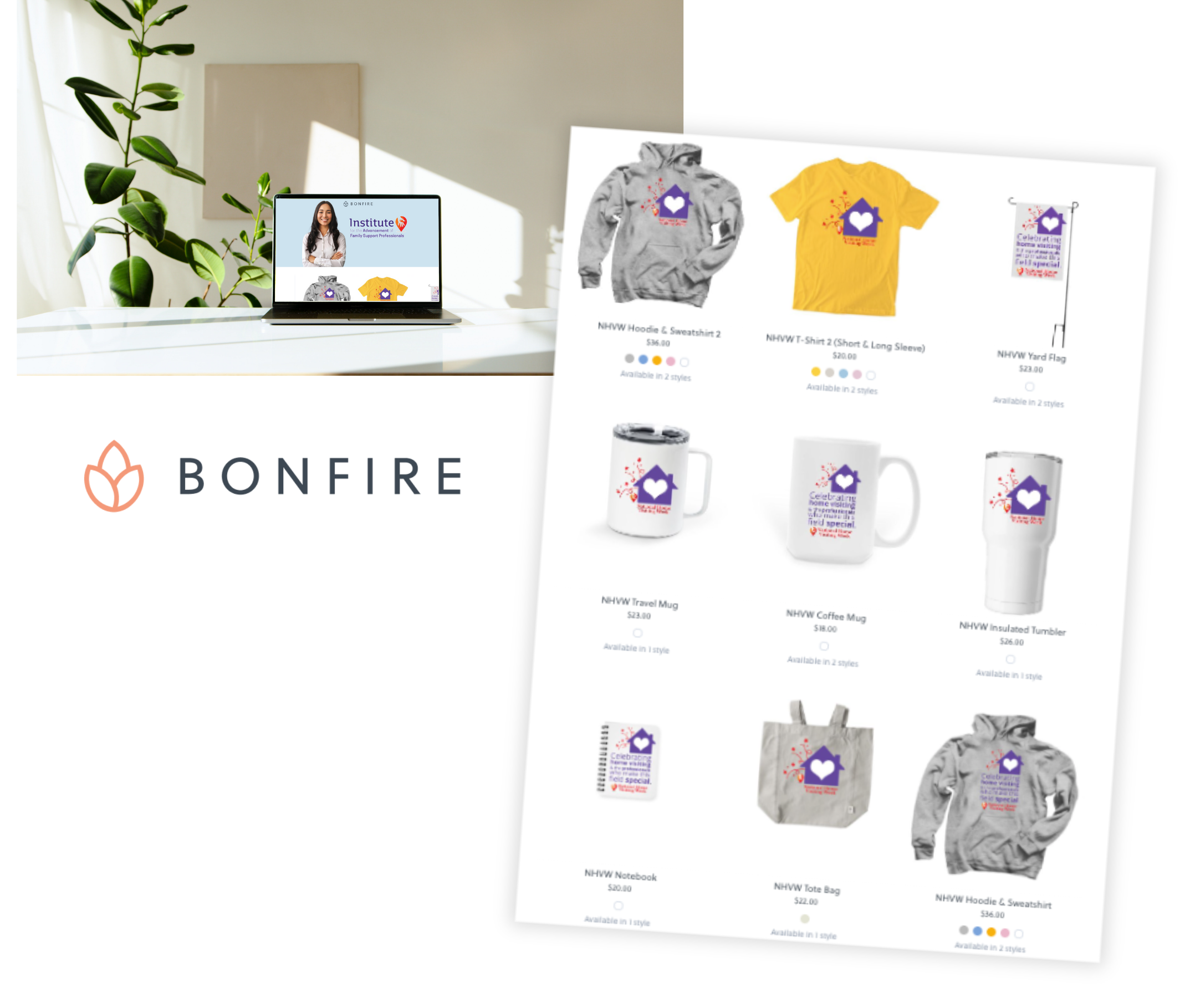
We have partnered with Bonfire to offer #NHVW merchandise for 2026! This professional online store allows programs and staff the ability to purchase t-shirts, hoodies and more without the need for large minimums and inventory requirements. Use these as incentives, rewards and ways to celebrate National Home Visiting Week!
*Be sure to order in time to have for NHVW!
Our Bonfire store can be found HERE.
If you wanted to create your own merchandise you can use any of the logos provided in this toolkit. If you needed something else, reach out!
And Yes, We Have Merch!
Need More Inspiration?
Why Early Childhood Home Visits are Cause for Celebration in R.I. READ MORE
Rep. Yakym, Colleagues Introduce Bipartisan National Home Visiting Week Resolution READ MORE
Save the Date to Appreciate Home Visitors READ MORE
County Proclamation: Cascade County proclaims April 2025 as National Home Visiting Week READ MORE
National Home Visiting Week: Incredible Work READ MORE
Kansas Celebrates National Home Visiting Week April 21-25 READ MORE
Readers’ Forum: National Home Visiting Week highlights support for families in need READ MORE
Montana: Celebrate National Home Visiting Week: April 21 – 25, 2025 READ MORE
#NHVW #NHVW2026 #NationalHomeVisitingWeek #HomeVisiting #HomeVisitingHeroes